

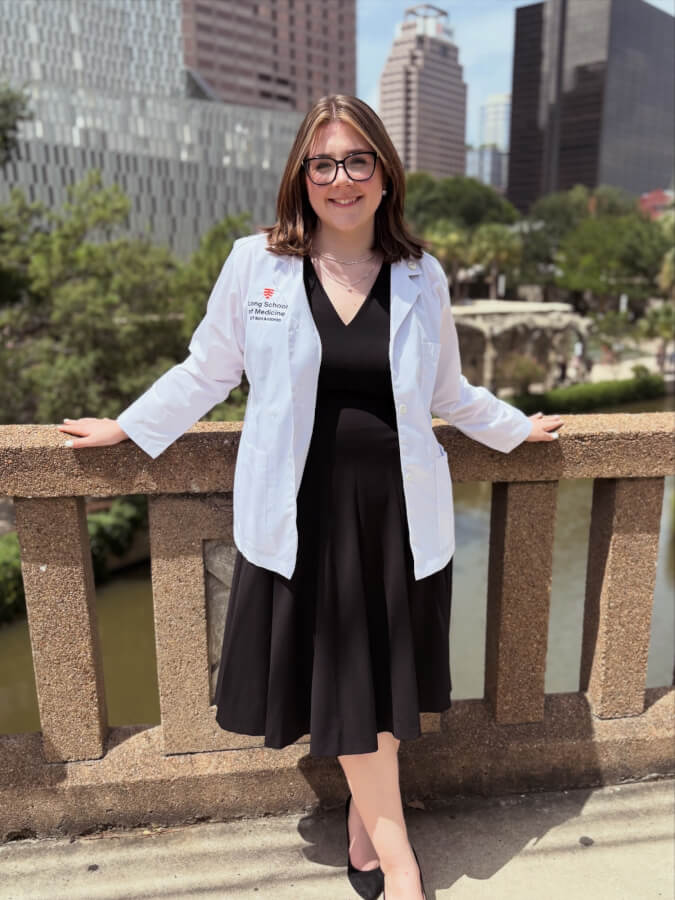
Alyssa Harig’s interest in medicine began as she watched television shows like “Dr. G: Medical Examiner” and “Untold Stories of the E.R.” with her mom as a youngster. She was so enamored with being a doctor, she would often pretend to place IVs on her dolls, she said.
“I most definitely had no idea what I was doing, but the passion was there,” she said. “The interest that I developed didn’t just stick with me, but only grew as I got older …”
As Harig later received real-world experience in the medical field through volunteering and shadowing providers, “caring for others was no longer a question, but rather, a certainty,” she said.
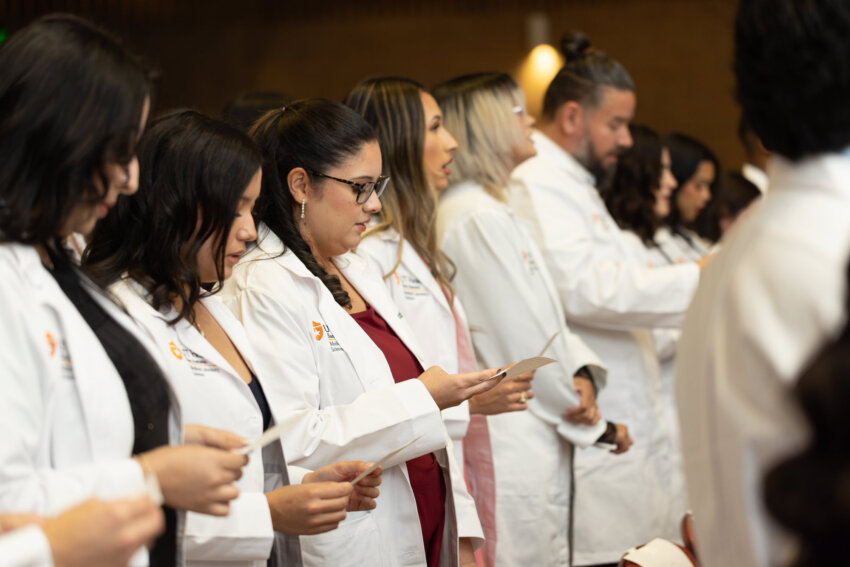
Her calling to medicine was further solidified during the Joe R. and Teresa Lozano Long School of Medicine’s White Coat Ceremony, a tradition symbolizing the official transition from student to medical professional-in-training. The late Arnold P. Gold, MD, a faculty member at Columbia University College of Physicians and Surgeons, established the ceremony in 1993 to underscore the importance of compassionate patient care from the beginning of medical training.
Over the past three months, six coating ceremonies have taken place across five of the six health professional schools at the university. They included:
- Long School of Medicine, July 18, Tobin Center for the Performing Arts
- School of Dentistry, July 18, The University of Texas at San Antonio Convocation Center
- School of Health Professions (Master of Physician Assistant Studies), Aug. 7, and (Medical Laboratory Sciences), Sept. 19, Holly Auditorium, The University of Texas at San Antonio (UT San Antonio) Health Science Center
- School of Nursing, Aug. 14, Holly Auditorium, UT San Antonio Health Science Center
- Graduate School of Biomedical Sciences, Sept. 18, Holly Auditorium, UT San Antonio Health Science Center
Long School of Medicine
During the Long School of Medicine’s ceremony, Harig was among 234 incoming medical students receiving their white coats and reciting the Hippocratic Oath in front of family, friends and faculty, formally joining the medical profession.
Students listened with avid interest as UT San Antonio President Taylor Eighmy, PhD, conveyed the importance of the white coat rite of passage.
“As the newest members of the medical community, you now carry the honor and privilege of living out your calling to lead with both excellence and compassion,” Eighmy said. “I have full faith you will achieve both, marking a very bright future for each of you and for our community at large.”
The ceremony was emotional for Harig, she said.
“Going to medical school had been a dream of mine for almost as long as I can remember, and that moment was finally happening. I was finally there,” Harig said. “What made it more impactful was having my family, the people who supported me this whole time, watched it happen.”
Watch a video of highlights from the Long School of Medicine’s White Coat Ceremony here.
School of Dentistry
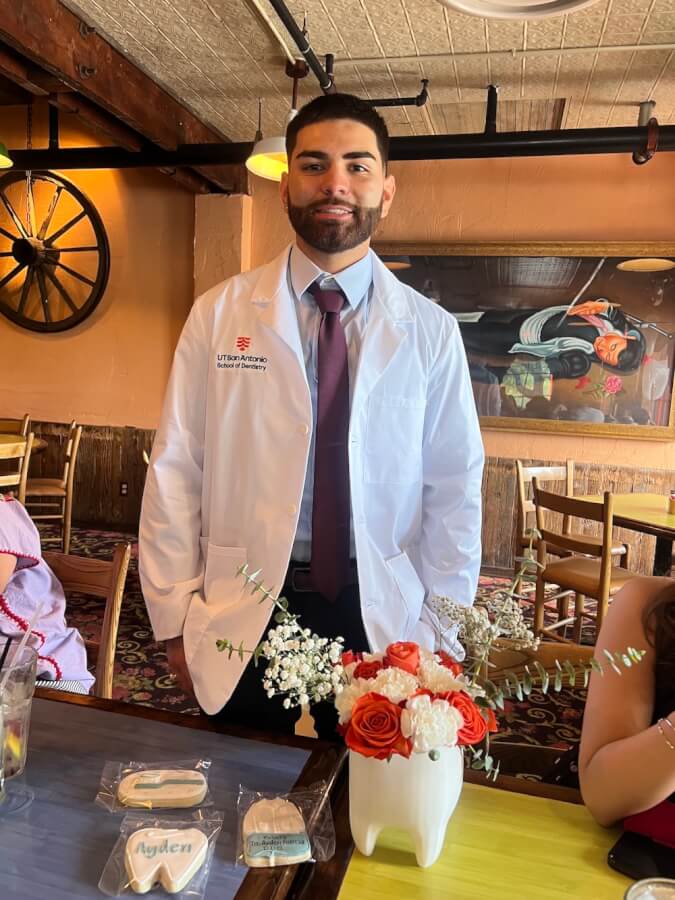
For Ayden Garcia, the passion to become a dentist stems from a family member’s lack of access to proper dental care.
“Seeing that from a young age stuck with me,” Garcia said. “It showed me how much of a difference access makes, and it made me want to be someone who closes that gap for other families like mine.”
On July 18, as the School of Dentistry welcomed its newest students during its White Coat Ceremony, Garcia was officially on the path to earning a Doctor of Dental Surgery degree and to providing the care that he would have liked his family member to receive.
“Wearing this coat, I stopped being someone who just watches problems happen,” he said. “Now it’s on me to fix them. I’ve spent years seeing people go without care they needed, feeling like there was nothing I could do about it. This coat means I stepped into the role of the one who helps.”
During the ceremony, 100 incoming Doctor of Dental Surgery students, 22 International Dentist Education Program students and 30 Dental Hygiene Program students, enthusiastically recited the Hippocratic Oath in front of family, friends and faculty, formally joining the dentistry profession.
In his address to attendees, Kenneth M. Hargreaves, DDS, PhD, professor and dean of the School of Dentistry, said receiving the white coat represents a commitment to improving lives through thoughtful, responsible care.
“Today’s white coat ceremony marks a significant moment, your rite of passage into the profession of dentistry,” he said. “The coat symbolizes your commitment to compassionate care and ethical practice and professionalism, emphasizing humanism’s importance in dental care. As you receive it, you join our worldwide family of dental professionals. But the work doesn’t end with dental school. Lifelong learning is essential and knowledge is power, so unless you’re committed to continuous learning, you will fall behind the profession. I welcome all of you to the profession and look forward to getting to know you over your time here and watching you launch your successful careers.”
Watch a video of highlights from the School of Dentistry’s White Coat Ceremony here.
School of Nursing
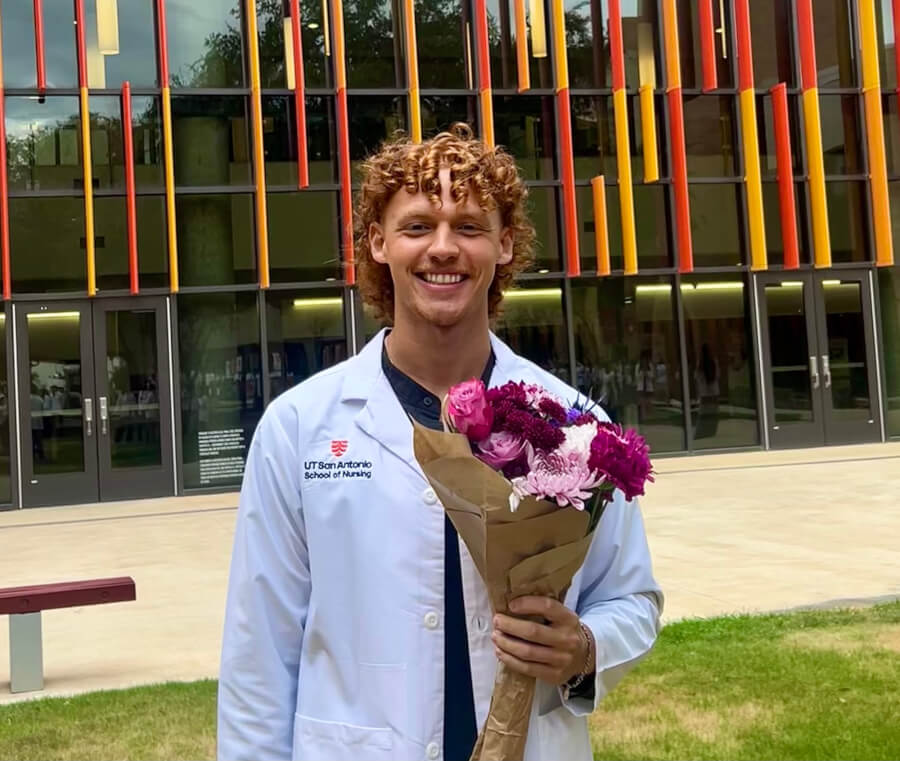
Before starting nursing school, Tyler Crow had long cradled the idea of being an engineer, envisioning a world where he could make a difference with his innovations. As he experienced more of life, he realized that for him, contentment was not in conceiving a revolutionary idea, but in making an impact through compassionate care.
“Looking back, even when I was young, I just liked to make people smile,” he said. “… Through nursing, I’m given that opportunity every day to share a tiny moment in someone’s life, and if I can bring just a little light to these patients in the midst of their toughest times, all the hardships, all the tests, all the [late-night] studying, would have been well worth it. I believe wholeheartedly that’s why God put me in this world, and I’m so fortunate … to know my calling.”
On Aug. 14, as the School of Nursing welcomed 161 students in the Bachelor of Science in Nursing (traditional) program with a White Coat Ceremony, Crow crossed a meaningful threshold, drawing closer to his goal of becoming a nurse.
“For our BSN students, this ceremony marks an important milestone as they take another step toward becoming the nurses our patients and communities need,” said Sonya Renae Hardin, PhD, APRN, FAAN, dean of School of Nursing. “We are incredibly proud of each of you and all that you have accomplished to reach this moment. Congratulations on this meaningful achievement, and welcome to the proud tradition of nursing.”
As Crow looked upon the faces of the professors and practitioners who had once been students, he felt a sense of both awe and humility.
“Now that I wear that same coat, it’s no longer just about me,” he said. “I represent more than myself. I represent my peers, my school, my profession under [an] obligation to do better and to be better …”
For Crow, receiving his white coat was a testament to the hard work he’d put in to experience that moment.
“For the longest time I had struggled to feel like I belonged,” he said. “… But getting to stand on that stage among my peers, I finally felt like I was exactly where I needed to be [by] talking to everyone and finding out I wasn’t the only person who felt this way. Actually, most were in the same boat. It made me realize that we were in this together.”
Watch a video of highlights from the School of Nursing’s White Coat Ceremony here.
Graduate School of Biomedical Sciences
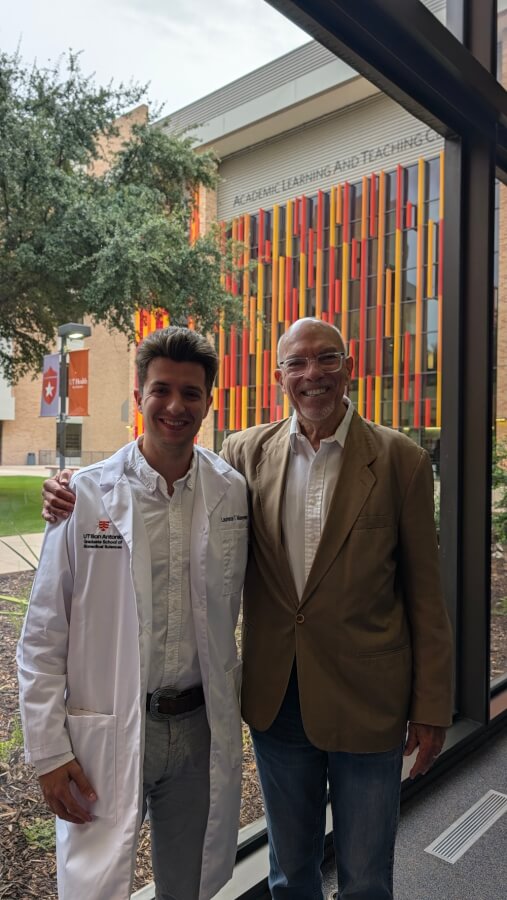
When Integrated Biomedical Sciences Graduate Program student Laurence Maeyens received his white coat at the Graduate School of Biomedical Sciences’ candidacy ceremony for PhD students, he took a significant step toward completing his doctoral degree.
For Maeyens, the white coat represented the work that had gone into developing his scientific foundation, as well as the responsibility to use that training to ask meaningful questions and contribute something new to the field of aging, he said.
“I hope to contribute to a clearer understanding of how and why we age at the most fundamental level,” Maeyens said. “If we can determine what controls the rate of aging across species and in response to different interventions, I believe targeting the aging process itself will become far more feasible. Ultimately, addressing aging at its root could delay or prevent many age-related diseases simultaneously, helping people live longer and healthier lives.”
Maeyens was among 47 of the 68 qualifying students who attended the candidacy ceremony on Sept. 18. During the event, Graduate School of Biomedical Sciences Interim Dean Tim Raabe, PhD, expounded on the importance of reaching this meaningful milestone.
“The White Coat Ceremony is traditionally associated with students entering medical school, symbolizing professionalism, compassion and a commitment to patient care,” Raabe said. “At the Graduate School of Biomedical Sciences, our Candidacy Ceremony celebrates a distinct and monumental milestone: the transition from student to independent researcher. Having successfully navigated rigorous coursework and qualifying examinations, 68 graduate students will receive their white coats as they officially advance to PhD candidacy, stepping into their roles as emerging scientists poised to lead innovative research, drive groundbreaking discoveries and make meaningful contributions to medicine, health and discovery.”
Watch a video of highlights from the Graduate School of Biomedical Sciences’ candidacy ceremony here.
School of Health Professions
Several School of Health Professions programs hold white coat ceremonies each academic year. The two most recent were those for the Master of Physician Assistant Studies Class of 2028, held Aug. 7, and the Medical Laboratory Sciences Class of 2027 ceremony, held Sept. 19.
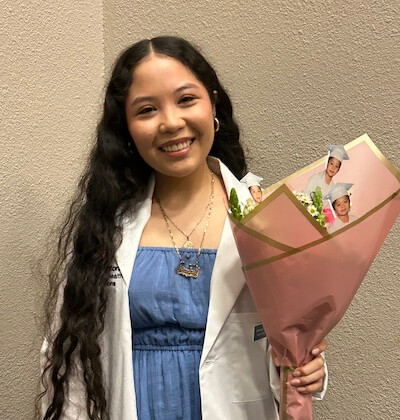
Physician Assistant Studies student Kimberley Murillo didn’t hesitate when asked to describe what receiving her white coat means to her.
“Perseverance,” she said, holding a bouquet of flowers after the ceremony.
A first-generation high school and college graduate, Murillo said she was motivated to become a physician assistant to increase access to healthcare in underserved communities.
“It means a lot being able to be here,” she said. “Every decision that my parents have made has led to me being in the position I am today. Being able to be successful in this program is something I am able to give back to them for all the sacrifices they have made.”
In his closing comments, Professor Paul B. Allen, Sr., DSc, MPAS, PA-C, DFAAPA, chair of the Department of Physician Assistant Studies, emphasized the duty symbolized by the white coat.
“Make no mistake that this white coat represents certain things to patients. At the very least it should represent to you as a future provider your duty to the patients you see,” Allen told the students. “It will be your honor to qualify daily to wear this coat.”
Watch a video of highlights from the Physician Assistant Studies’ White Coat Ceremony here.
During Medical Laboratory Sciences ceremony, Bridgett Piernik-Yoder, PhD, OTR, FAOTA, interim dean, School of Health Professions, also reflected on the significance of the white coat tradition, stating that the garment symbolizes students’ commitment to providing excellent, accurate and trustworthy clinical services.
“The white coat ceremony … marks the moment a person publicly accepts the ethical and professional obligations of their field, which extends beyond technical skills,” Piernik-Yoder said. “It represents a commitment to bring precision and integrity to every test performed and every result reported, and a recognition that behind every specimen is a person, and often a family, seeking answers.”
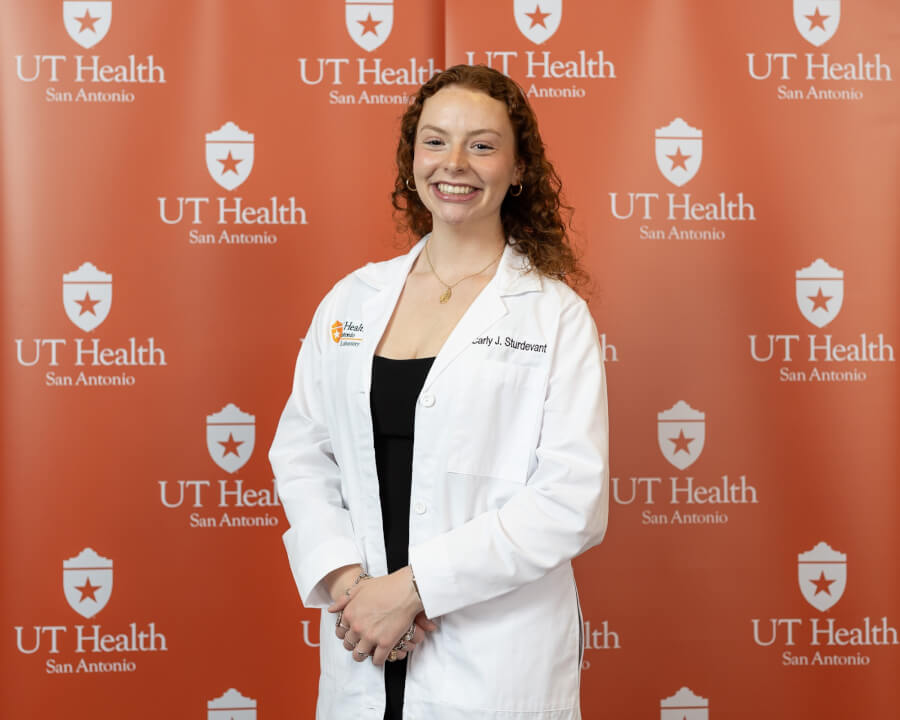
For master’s student Carly Sturdevant, president of the Medical Laboratory Sciences class of 2027, receiving her white coat validated years of hard work and was especially meaningful because she experienced it with her peers.
“We’ve all worked very hard to make it this far in the program,” she said. “[The ceremony] marks the start of our clinical journey between October and November when everyone starts to leave for clinicals. And for me, it’s a reminder that I’m committing to lifelong learning within this field.
Sturdevant said the ceremony also is “a reminder that all patients deserve the same respect and humility, and that it’s a privilege to be a healthcare provider. I was born and raised in San Antonio, so getting to give back to my community is a big part of what I’m excited for.”
Looking to the future, Sturdevant hopes to bring more awareness to the field of medical laboratory sciences, a field in which healthcare professionals analyze blood, tissues and other patient samples to support the diagnosis and treatment of diseases.
“It’s definitely more of behind-the-scenes [work],” Sturdevant said. “We don’t have exact patient interaction, but the work that we do is still an essential part of patient care.”
The Respiratory Care program will hold its white coat ceremony in February 2027, while the Doctor of Occupational Therapy and Doctor of Physical Therapy programs will hold their white coat ceremonies in May 2027.
Watch a video of highlights from the Medical Laboratory Sciences’ White Coat Ceremony here.
Inspiration for future health professionals
After receiving their white coats, students from the university’s five schools had achieved an unforgettable milestone, embarking on a path that would fulfill a sacred promise. A promise to provide compassionate care. A promise to provide ethical care. A promise to make lives better.
As Robert Hromas, MD, FACP, professor at the Long School of Medicine, addressed medical students at their white coat ceremony, he offered sage advice that could apply across all health professions.
“Have enough wisdom to always be careful when making decisions that affect the lives of your patients, no matter how many times you have done it before,” Hromas said. “Start learning medicine from the inside out first, learn the heart of healing before healing itself, and you will do well as a physician.”